
The Cut Outs
Matisse's joyous final movement
Near the exit of the exuberant and optimistic Henri Matisse exhibit at the Grand Palais in Paris, there’s a quote from the artist, bidding farewell visitors to the just-closed show in a classic Matissian manner of celebrating the joy of life:
“I hope that however old we live to be, we die young”
I recently took my photo under these words, my just-purchased-at-a-Paris-boutique brown checkered dress and plum print scarf a pop of pattern and color against the white wall, on my third and final visit to the Matisse exhibit.
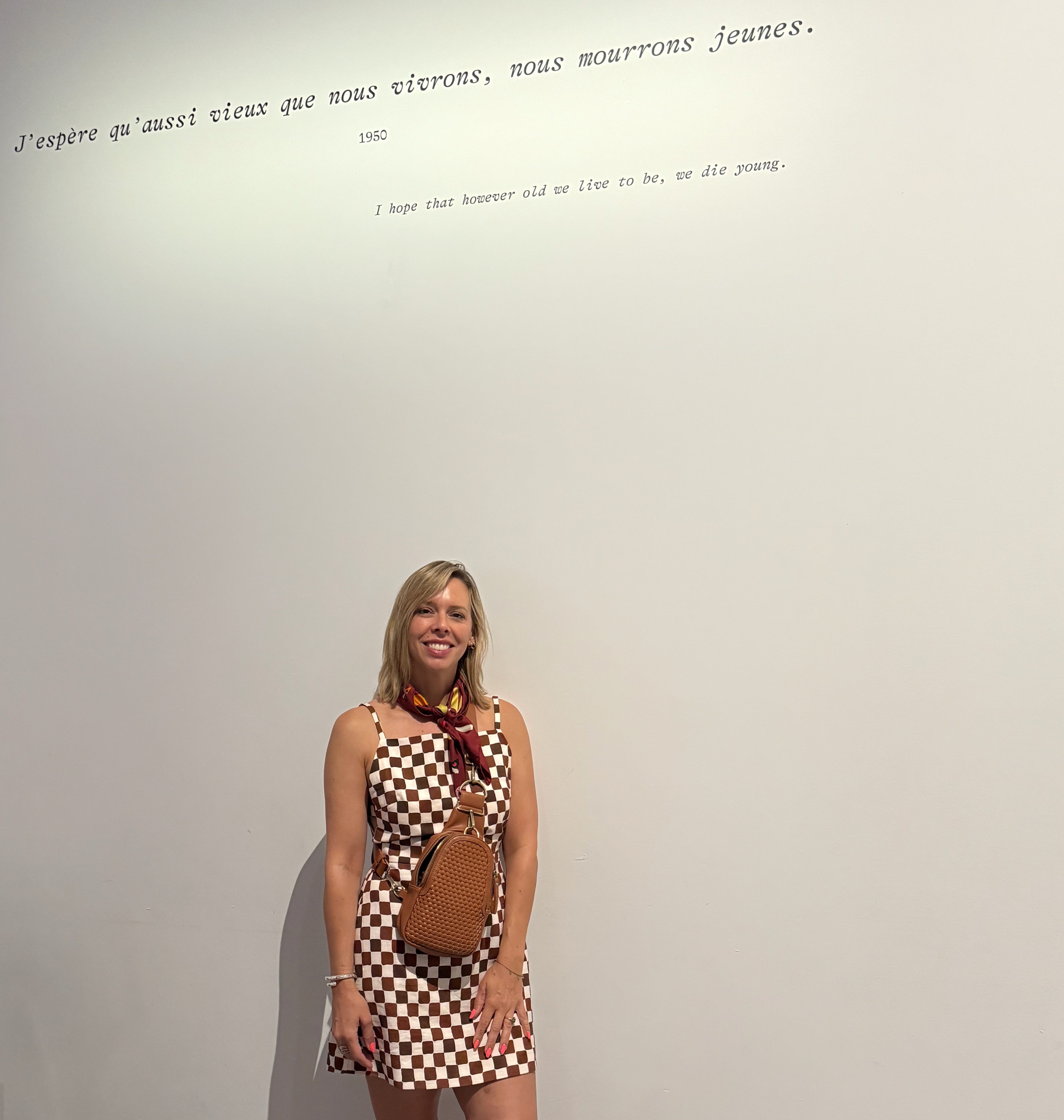
It was the last hour this exhibit would be open to the public. In fact, it was closing early because the Paris police had asked the museum to close at 3pm to clear the Champs Elysées before the Tour de France riders flashed by. Realizing it would be the last time I’d ever see these artworks in this exact formation, I lingered. Content, I walked out. Seconds later, applause erupted behind me. I tried to slip back inside, hoping to join what I imagined was a spontaneously thank you — to the museum staff, or perhaps to Matisse himself — but the applause was short lived. The exhibit closed. I managed to see it three times during its five month run. (Yay to living in Europe!)
Matisse is my favorite artist not only because I adore his colorful and energetic depiction of his subjects — women, cozy rooms with windows, plants, blobs and squiggles, all so imbued with personality — but for how he lived his life. Namely, using joy and beauty as a protest and how he always learned and played, which is something that kept him young and prolific right until the end.
The optimism of his work is especially remarkable considering he created many of his most beloved paintings and cutouts at the end of his life while suffering numerous health issues. Also, it was WWII in France. Matisse himself managed to evade Hitler’s wrath, but his wife and his daughter were arrested for working for the resistance in Nazi-occupied France. His daughter, Marguerite was interrogated, and tortured by the Gestapo, sent to a concentration camp, but she managed to escape when the train carrying her there was halted by an air raid. She hid in a forest and was rescued by the French resistance. This profound ordeal left a major impact on her father, but he didn’t suddenly start painting dark scenes of anguish and despair. Some critics have argued that his work after his daughter’s ordeal was even more focused on beauty, light, and interior peace. I see his serene paintings and his joyful cutouts not as a naive retreat from the harsh and evil world but as a direct protest of those dark forces. To continue to find beauty in a world with so much suffering is the hardest and most impressive thing a human can do.
(Below is his famous cut-out “Icarus” from 1947).
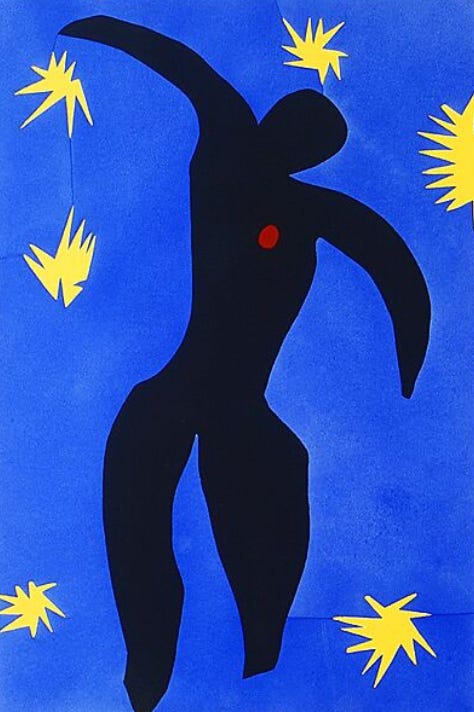
When Matisse reached old age, he couldn’t paint with the same precision as he used to so he invented a new art form: the cut-out. He’d paint sheets of paper, let them dry, then use very large metal scissors to cut them out into shapes. Sometimes the shapes were depicting things he’d painted earlier in his career, like furniture in a room and women. Sometimes they were huge almost hieroglyphic squiggles, like the shapes he plastered on the walls of his home.


Even with age and ailing health, Matisse didn’t sit down and lament art as young man’s game. He seemed to have thought about what he could do with his current abilities, drawing on his years of experience. He created a new art form, one he’d ultimately become just as famous for as anything else he’d done.
Reinvention rarely comes from completely starting over, but rather drawing on years of skills and experience. In Matisse’s case, he had spent his whole life diligently and joyfully studying art — including learning to draw the essence of a face without being beholden to its physical appearance — and so transitioning to a new form like paper cutouts was natural. He spoke of this type of preparation when he spoke of making the kinetic bouncy blue figures in his acrobat series. He said that he, like acrobats, practice extensively, so when the time comes, they can throw themselves in without any restraint.
“It is in order to liberate grace and character that I study so intently before making a pen drawing. I never impose violence on myself; to the contrary, I am like the dancer or tightrope walker who begins his day with several hours of limbering exercises.”
As we move into new chapters of life, we’re never totally starting anew. More like afresh. We have at our disposal all our skills and many of our resources to create something different at any stage of life.
In the early days after my husband left me, I was frozen with fear for a short time. We had lived abroad for more than a decade for his job as a U.S. diplomat. When I was suddenly faced with the end of that chapter of life, it felt like a great loss. As we negotiated how to split our finances via a divorce agreement, it was frequently pointed out to me - by my ex-husband, by my lawyers, by my friends - that I have abundant skills and would surely be fine on my own. I never felt like a victim, partly because no one allowed me to, including myself. Those abundant skills haven't exactly translated into abundant income (yet) but they are real. Everything I learned during my years abroad — decorating homes, writing, cooking, diplomacy, building community, meeting artists and artisans — all of it became the limbering exercises Matisse described. I wasn't starting over. I was starting again with different materials.
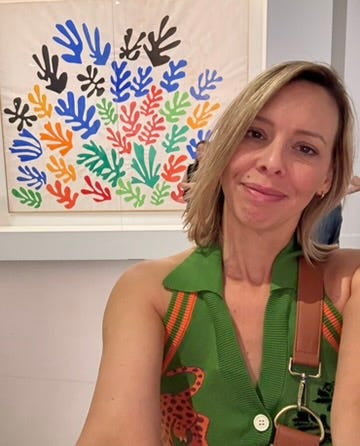
During that time of transition post-divorce, as I was figuring the contours of a new single life based in Washington DC, I got a tattoo that says “create” which is partly a reminder to myself of my power to create: connections, art, the life I want. It was my first tattoo and the only time I’d felt something strongly enough to want it etched onto my skin forever. But the other day as I stood in front of Matisse’s red and blue and green and yellow cut-out explosion of dancing sea-creature-like shapes, I knew it: I want this artwork permanently with me.
What I’m Reading
Feels like for the better part of six weeks, I haven’t been quite 100% health-wise. What I suspect to be bronchitis ended up inflaming a nerve in my inner ear causing vertigo which turned into my current state of off-kilterness. (There’s a special kind of bummer to being sick in the summer, isn’t there?) Anyways, one day earlier this month, Nomi brought me home a book from the smallish English language section of the bookstore and told me “I can tell you miss reading physical books.” (I left nearly all of my books back in DC and figured this would finally be time I used the Kindle. But you know what, I just like the tactile feel of a book. Practically as much as I detest the slim electronic phone-like feeling of Kindle). Anyways, the book was The Calamity Club by Kathryn Stockett and while it wasn’t the usual genre I’d read, I really enjoyed it. Plotty as heck. Depression-era Deep South. Closeted gays. Prostitutes. Actual laws against Black people and white people having contact. A history lesson in all the myriad laws (some still on the books) designed to control women. Interesting stuff. But also a reminder of the importance of plot, which is generally the least important part of my preferred genre of literary fiction.
And when I was in Paris last weekend, I went the charming Abbey Books a packed-to-the-brim used bookstore in the Latin Quarter and bought an Edith Wharton trilogy, I Love Dick by Chris Kraus, and Land by Maggie O’Farrell, the latter of which I’m already bog-deep in the viscerally harrowing setting of post-famine Ireland in the 1860s.
What I’m Watching
I always have a late-night comfort watch going, and it’s currently my third time through BoJack Horseman. Don’t let the bright color cartoons fool you: This is a show about depression and the search for human connection and it’s not light, although it is very funny. Nomi and I finished Widows Bay, and it was the best series I’ve seen in years - laugh out loud funny and just the right amount of spooky and scary. The tone almost reminded me of the movie Hocus Pocus, actually. It was so good I wish I hadn’t seen it yet so I could have the pleasure of watching it all anew with fresh eyes.
What I’m Designing
In my own super modern townhouse in Ljubljana, I finally hung up some art above the sofa and I can’t tell you how much it cozied up the place. I am also really enjoying doing one-hour interior design consultations with clients. The past several, we’ve gone through their home virtually, and talk about their hopes and dreams for each room and I give concrete design direction. Super satisfying. If your living space isn’t quite where you want it to be, consider booking a session with me. I promise you’ll leave with some real good ideas.
Okay that’s all for now. Nomi and I are off to Croatia for a weekend on the Adriatic Sea. Reading, swimming, eating seafood and salads. Summer-ing, basically.
To drawing on your abundant skills and making something fresh in your next chapter,
Emily
Cannot wait to see your new tattoo! Glad u are healthy again! Great post!
This was an inspirational read--thank you. :) FELIX.